
Stories
In a rented 550-square-foot workshop tucked into South Donia, Kadamtoli, the steady hum of machines making electric switches and socket connectors used to compete with something else: the anxiety of rising power bills and the disruption of frequent load-shedding. Today, that hum is powered increasingly by sunlight.
Shabiha Akter Pinky, 31, runs Aual Electric Product, a small manufacturing enterprise that employs six workers, two men and four women, producing switches and socket connectors for the local market. Like many microentrepreneurs in Bangladesh’s metal products sub-sector, Pinky built her business the hard way, growing it into an operation with a total investment of BDT 25 lakh and dependable profits. But growth came with a cost: heavy dependence on grid electricity, mounting energy bills, and the vulnerability that comes with unpredictable power supply.
That began to change when Pinky, supported by ‘BASTOB – Initiative for Peoples Self Development’ under the SMART project, decided to adopt Resource-Efficient and Cleaner Production (RECP) practices at her factory.
With a BDT 20,000 RECP grant and a first-time loan of BDT 8 lakh, she installed a solar power system to run her lights, fans, water pump and equipment; introduced proper waste storage for metal dust through a dust collector; and added an exhaust fan to improve air circulation on the factory floor.
“After installing solar panel, I don’t use electricity from the national grid during the entire daylight hours. As a result, my monthly electricity bill has been reduced. When other factories are closed due to load shedding in the area, work continues on a small scale in my factory.”
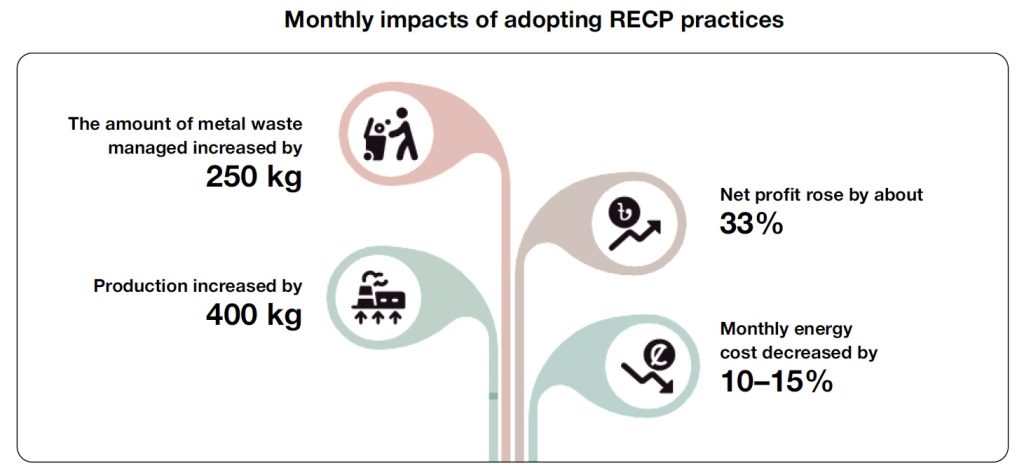
The numbers back up her experience. Since adopting RECP practices, Pinky’s production has climbed from 1,800 kg to 2,200 kg, while her energy costs have dropped by 10 to 15 percent: from BDT 22,000–25,000 to BDT 20,000–22,000 per month. Her net profit has grown from BDT 5–6 lakh to BDT 7–8 lakh, and rather than discarding metal waste, she now collects and sells roughly 1,050 kg of it, up from 800 kg previously left unmanaged.
The changes extend beyond the balance sheet. With solar power now running lights, fans and even a CCTV camera, and with the dust collector keeping the workshop cleaner, Pinky also invested in two split air conditioners to improve conditions for her staff.
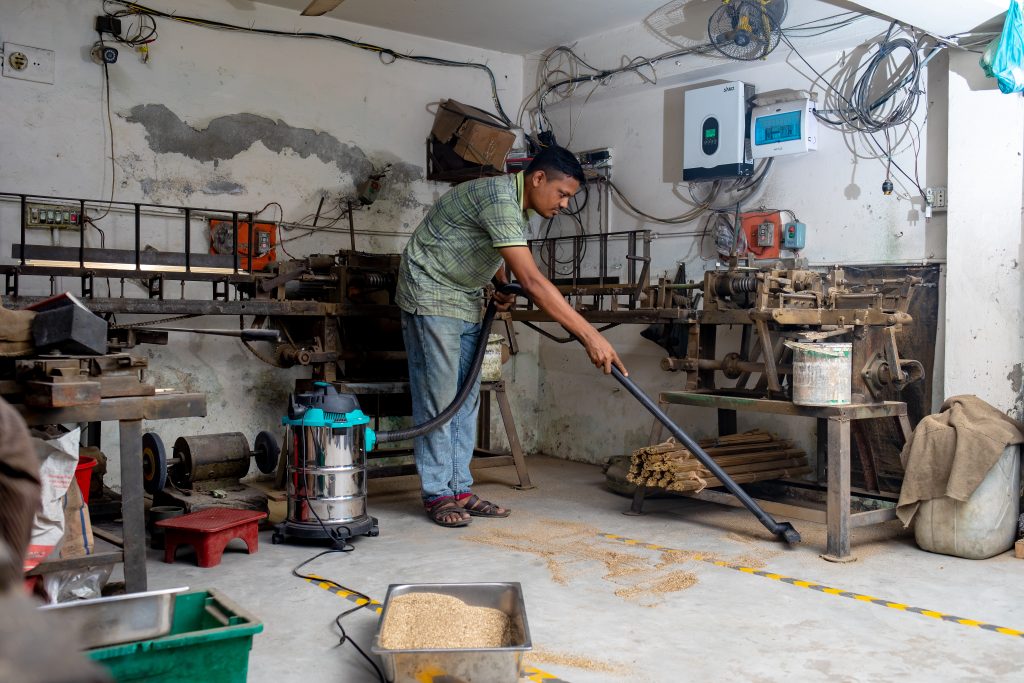
The effect on morale has been tangible. “We have a nice working environment in the factory. So, we are encouraged to work more in this comfortable environment in the heat, and the working spirit has also increased,” says one of the factory’s workers.
Pinky’s transformation has not gone unnoticed in her community. Other micro-entrepreneurs, curious about the advantages and disadvantages of going solar, have visited her factory to see the system for themselves — and she has become an informal advocate, encouraging her neighbors to make the switch to cut their own electricity costs.
She has also linked her business with the Bangladesh Electrical Merchandise Manufacturers Association (BEMMA) to expand her market reach.
Looking ahead, Pinky wants to grow further: expanding into new territories, strengthening her product branding to reach more buyers, and building her capacity in e-commerce-based marketing. With continued support, she is confident her cleaner, more efficient factory can become an even bigger source of livelihoods in her community.