
Stories
Everywhere you look in Haria village of Jhikargachha upazila in Jessore, you can see eye-catching flower fields. Yet the worries of flower farmers are endless. The vast fields are filled with a variety of flowers including roses, marigolds, gerberas, chrysanthemums, and more. However, it becomes difficult for flower farmers to calculate their profit and loss at the end of the season. The ever-increasing prices of chemical fertilizers and pesticides, the cost of excessive water use and irrigation, the weeds that accumulate on the land, and the plant remains after harvesting flowers—all of this, like for all other flower farmers, constantly cast a shadow of uncertainty over Reshma Khatun (30).
Reshma’s voice carries regret, “Even though I cultivated flowers using the methods I learned from my parents, it was difficult to bring home a profit.” The constant reliance on chemical fertilizers and pesticides in conventional farming not only increased costs but also destroyed the soil quality of her land. The excessive use of pesticides to control insects was reducing the quality of her flowers. Sometimes the flowers did not even fetch the right price in the market. Water wastage was another major problem. Electricity bills were increasing due to excessive irrigation, as was the reliance on groundwater.
As losses mounted, continuing to cultivate flowers on two bighas of land became an uphill battle for Reshma. A family of five members, workers’ wages, and an uncertain income at the end of the season — all these worries seemed to be overwhelming her.
In the midst of this crisis, PKSF’s SMART project emerged as a ray of hope. Reshma joined the project through the Rural Reconstruction Foundation with a great hope. Although she was skeptical at the beginning, her conventional thinking began to change through training. Reshma first learned about the Resource-Efficient and Cleaner Production (RECP) practices through the project. Through training in eco-friendly farming methods, she learned about modern methods of flower cultivation at low cost, reducing waste without harming the environment. Under the project, she started her eco-friendly flower cultivation journey with a loan of three lakh taka.
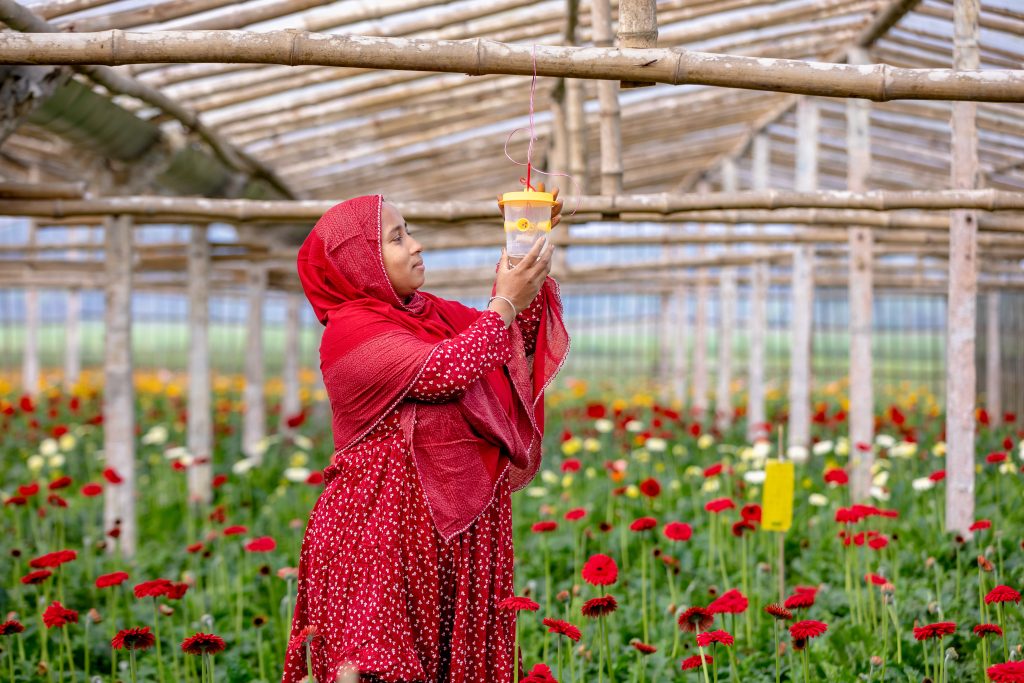
Reshma started using organic fertilizers and organic pesticides with renewed enthusiasm. The health damage caused to her and the workers by using chemical fertilizers and pesticides has also shown positive change. In addition, instead of chemical sprays, she started using colored traps and pheromone traps to control insects. This reduces costs, improves the quality of flowers, and keeps the flowers fresh for longer. Additionally, she avoided the previous ‘flood irrigation’ method and started irrigating the flower fields in a controlled manner using hose pipes. This not only reduces water wastage but also lowers her electricity bill and reduces her dependence on groundwater.
The waste that used to accumulate in the field after collecting flowers has now become a new resource with the advice of the project. She is now making organic fertilizer from flower residues and organic waste. Reshma says, “What I used to throw away before is now food for my land. This organic fertilizer now helps retain soil moisture and increases soil fertility.”
She has witnessed the results of this change with her own eyes. Where her seasonal income was once around BDT 175,000, it has now increased to BDT 225,000. In just a year, Reshma’s income from two bighas of land has increased by BDT 50,000.
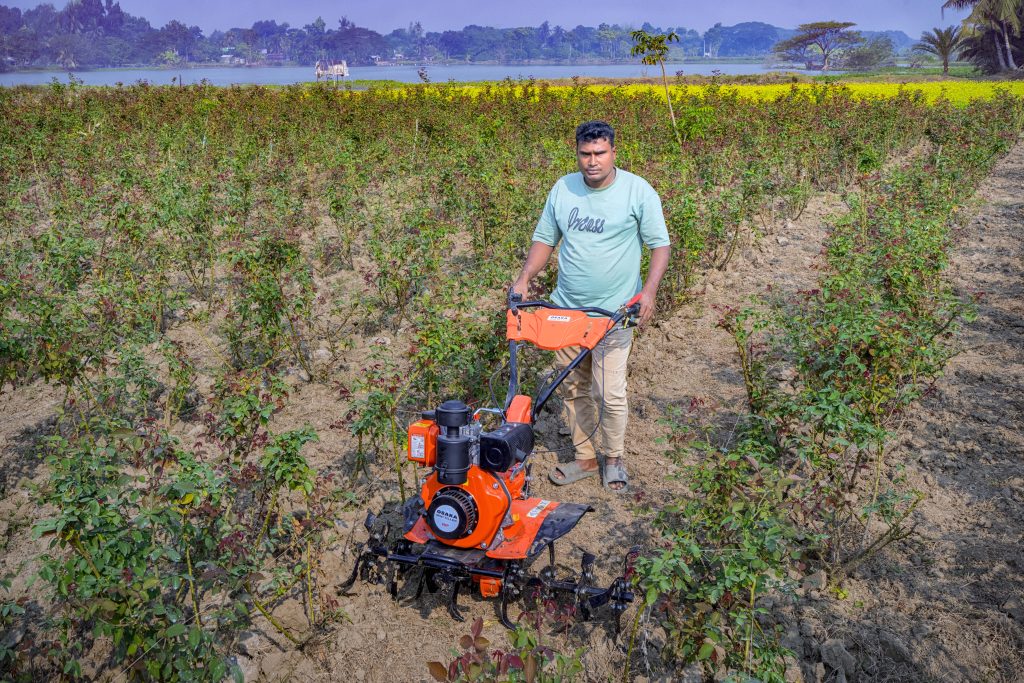
Reshma purchased a mini power tiller to mechanize and modernize the farm. This has reduced the dependency on labor and significantly increased the speed of work. Reshma says with a smile, “Earlier, I needed more workers for cultivation and weeding. Now, one worker can do the work of cultivation and weeding with machines.”
Today, that flower field in Haria village is no longer just a picture of worry. There are signs of change. Reshma herself now teaches others about environment-friendly flower farming methods. She is involving people in environment club meetings. Following her path, other flower farmers have also started cultivating in a new, environment-friendly way.
Reshma is a successful flower farmer today, having overcome past losses. She has proven that the right advice, knowledge, training, timely support, and environment-friendly decisions can change the life of a woman, a field, and even the future of a village.
The soft afternoon light slowly spreads across the flower fields. Rows of marigolds and gerbera flowers sway in the wind. Reshma Khatun stands in the middle of the flower fields. There is no fatigue in her eyes, only a deep expectation as she looks into the distance. She dreams of one day cultivating more diverse flowers. Her own brand of flowers will be developed. Flowers will be sold online, and their fame will spread to different parts of the country.